
 Jacksonville, FL
 Call (904) 337-4000

Businesses worldwide are investing heavily in technology to gain a competitive edge, but the challenge is that with a clear IT strategy, even the most substantial investments can save resources. It’s not enough to spend on IT—you need a roadmap that aligns technology with your business goals.
“An effective IT strategy transforms technology from a cost center into a growth engine, driving innovation and measurable business outcomes.” — Philipp Graves, CEO of Antisyn.
Are you driving digital transformation or simply spending to keep up? With IT expenditures climbing, now is the time to ensure every dollar you allocate delivers measurable value. In this blog, you’ll discover actionable steps to create an IT strategy that drives innovation, improves efficiency, and positions your business for long-term success.
What is an IT Strategy?
An IT strategy is a roadmap that aligns your technology investments and operations with your business goals. It outlines how IT will support your organization, drive innovation, and improve efficiency.
Key Components of an IT Strategy:
- Vision and Goals: Where your IT efforts should take you.
- Resource Allocation: Budgeting and resource management.
- Performance Metrics: KPIs to measure success.
Understanding what an IT strategy is is the first step toward leveraging technology as a strategic asset.
Optimize Your IT Strategy with Expert Guidance
Partner with a team that turns technology into your competitive edge.
Why Developing an IT Strategy Matters
A well-crafted IT strategy ensures your technology investments yield measurable results. Here’s how:
- Improves Operational Efficiency: Streamlined processes save time and money.
- Enhances Security: Mitigates risks with proactive measures.
- Drives Growth: Aligns IT initiatives with business expansion.
Without a clear IT strategy for business, you risk falling behind competitors who capitalize on technology-driven opportunities.
| Learn More About How You Can Fuel Your Digital Transformation |
Steps for Developing an IT Strategy
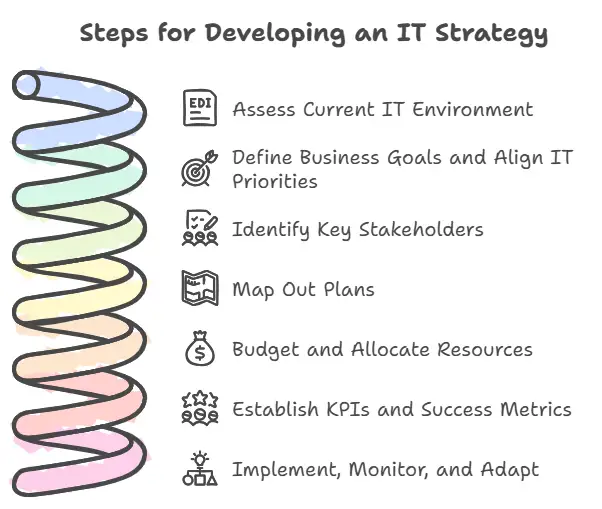
Developing a robust IT strategy requires a methodical approach to ensure alignment with your business goals and optimal resource utilization. Below are detailed step-by-step processes for creating a solid IT strategy.
Step 1: Assess Your Current IT Environment
Before you can plan for the future, you need a clear understanding of your starting point. Conduct a comprehensive IT audit that includes:
- Infrastructure: Evaluate hardware, software, and network capabilities. Identify outdated systems that need upgrades or replacement.
- Processes: Document workflows and assess how efficiently they integrate with your IT systems.
- Pain Points: Engage teams across departments to uncover bottlenecks, recurring issues, and unmet needs.
- Security Posture: Review your cybersecurity measures, compliance gaps, and vulnerabilities.
- Technology Utilization: Identify tools and platforms that are underused or redundant.
This assessment provides a baseline, helping you identify where your IT capabilities excel and where improvements are needed.
Step 2: Define Business Goals and Align IT Priorities
Your IT strategy must serve your business objectives. Start by answering these questions:
- What are your business goals? Whether it’s scaling operations, improving customer experience, or reducing costs, these should guide your IT priorities.
- What role should IT play? Decide whether IT will primarily support operations, drive innovation, or a mix of both.
- What challenges must IT address? Define specific problems that IT solutions need to solve, such as streamlining supply chain processes or enabling remote work.
Once goals are clear, translate them into IT priorities. For example:
- If you’re aiming to enhance customer experience, prioritize CRM tools and analytics platforms.
- If growth is the focus, look at scalable solutions like cloud services or automation.
Alignment ensures IT initiatives directly contribute to achieving measurable business outcomes.
Step 3: Identify Key Stakeholders
Building an IT strategy is not a solo endeavor. You need input and buy-in from stakeholders across the organization.
- Decision-Makers: Include executives who oversee budgets and approve large-scale IT investments.
- IT Team: Collaborate with technical experts to understand system capabilities and limitations.
- End-Users: Involve employees who will interact with IT tools daily to ensure usability and adoption.
- External Partners: Consult with managed IT service providers or consultants for specialized insights and support.
Early involvement fosters accountability, ensures diverse perspectives, and minimizes resistance during implementation.
Step 4: Map Out Short- and Long-Term Plans
Strategic planning involves balancing immediate needs with future goals.
- Short-Term Plans: Identify quick wins that address pressing issues or provide immediate ROI, such as upgrading outdated software or implementing cybersecurity measures.
- Long-Term Vision: Plan for scalable solutions that can grow with your business. For instance, a long-term goal might include transitioning to a hybrid cloud infrastructure.
Use frameworks like roadmaps or Gantt charts to visualize timelines, dependencies, and milestones, ensuring team clarity and accountability.
Step 5: Budget and Allocate Resources
A well-defined budget is critical for implementing your IT strategy effectively.
- Determine Costs: Break down expenses into categories like hardware, software, staffing, training, and maintenance.
- Prioritize Investments: Focus on initiatives with the highest ROI or those that align most closely with business goals.
- Allocate Resources Wisely: Outsourcing tasks like complex cybersecurity can be strategic, especially if in-house expertise is limited. Managed services, for example, can reduce IT costs by 25% and boost operational efficiency by 50%, allowing you to focus internal resources on core business goals.
- Plan for Contingencies: Set aside a portion of your budget for unforeseen expenses or emerging opportunities.
This step ensures financial feasibility while minimizing risks associated with overspending or underfunding.
Step 6: Establish KPIs and Success Metrics
Without clear metrics, it’s impossible to measure the success of your IT strategy.
- Define Relevant KPIs: Metrics might include system uptime, application performance, cost savings, employee productivity, or customer satisfaction.
- Set Benchmarks: Establish baseline performance metrics from your current IT environment to measure progress.
- Monitor Continuously: Use dashboards and automated tools to track KPIs in real time.
- Adjust as Needed: If a KPI isn’t being met, reassess the underlying strategy and make necessary adjustments.
By measuring outcomes, you can demonstrate value to stakeholders and ensure continuous improvement.
Step 7: Implement, Monitor, and Adapt
The most meticulously planned strategy is only as good as its execution.
- Implementation: Roll out initiatives in phases to minimize disruption. Communicate changes clearly to all affected parties.
- Monitoring: Use tools like network monitoring software, project management platforms, and analytics dashboards to track progress.
- Feedback Loops: Collect ongoing feedback from stakeholders to identify areas for refinement.
- Adaptability: The technology landscape evolves rapidly; ensure your strategy remains flexible to accommodate new innovations, market trends, and changing business needs.
A continuous cycle of implementation, evaluation, and adjustment ensures your strategy stays relevant and impactful.
Common Challenges and How to Overcome Them
Challenge: Misalignment Between IT and Business Goals
Solution: Regular collaboration between IT and business leaders.
Challenge: Budget Constraints
Solution: Prioritize initiatives with the highest ROI.
Challenge: Resistance to Change
Solution: Offer training and clear communication to ease transitions.
Navigating these challenges ensures your IT development strategy stays on track.
How to Keep Your IT Strategy Relevant
- Regular Reviews: Schedule annual strategy updates.
- Embrace Trends: Stay informed about emerging technologies.
- Train Teams: Ensure your workforce evolves with technological advancements.
Future-proofing your strategy is just as important as developing your IT strategy initially.
Traditional IT Management vs. Strategic IT Development
| Aspect | Traditional IT Management | Strategic IT Development |
| Focus | Maintenance and troubleshooting | Alignment with business goals |
| Budgeting | Reactive | Proactive |
| Metrics | Uptime, issue resolution | ROI, innovation-driven outcomes |
| Adaptability | Limited | High |
Ready to Transform Your IT Strategy? Partner with Antisyn Today
Your IT strategy is more than just a roadmap—it’s the bridge between your business’s potential and its reality. Imagine having technology that not only supports your operations but also actively propels your growth, adapts to your needs, and safeguards your future. That’s the power of a well-crafted IT strategy, designed with innovation and resilience at its core.
At Antisyn, we bring years of expertise to the table, helping businesses like yours turn IT into a catalyst for success. Whether you’re starting from scratch or refining your approach, we’re here to guide you every step of the way.
Contact us today to schedule a consultation and take the first step toward IT excellence.
| Achieve Your Business Goals Faster With Expert IT Consultants in Florida | |
| Jacksonville | |
